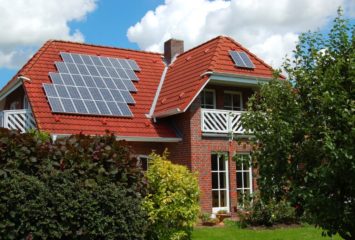
Comparison of home solar panel on-grid and off-grid power systems

| | Comments (0)

As choices for commercial solar power systems continue to expand due to innovations such as concentrating solar, mechanical solar and thin film solar panels, choices for home solar power systems are still limited to standard silicon wafer-based photovoltaic solar panels.

While standard solar panels may look the same, their performance varies widely, and is measured a number of different ways. The most informative measure of performance is conversion efficiency, or what percentage of light energy that hits the panel gets converted into electricity. However, this doesn't tell the whole story. The average homeowner will only cover a portion of their southern-facing roof with solar panels due to cost constraints, and therefor maximum watts per square foot is not so important. A measure of performance that will be more useful is dollars per watt of electricity from the panels. The lower this number, the less you will have to pay per unit of energy, making the decision between different solar panels much simpler. Unfortunately, manufacturers won't provide this number for you, so you'll have to do some calculations on your own.

Luckily, the information necessary to calculate this is available for most big manufacturers. There are plenty of websites online where you can find both the price of the solar panels and the output in watts. Then you can calculate the price per watt using the equation:

price per watt = cost per panel / watts per panel

Due to increasing demand, however, many high-end panels are only sold through affiliated resellers, and sometimes only as a package including installation. Because of this it is often impossible to find the price of their panels online. You may have to contact the resellers and get a price quote to find out the cost per panel. However, because solar panels are such a large investment, it is worth spending the extra time doing research. That extra few hours you spend might enable your household to become a net energy producer instead of a net energy consumer, allowing you to sell energy back to the grid instead of having to supplement the energy provided by your solar panels with energy from the grid.

SunPower is currently mass-producing some of the highest efficiency solar panels available for the residential market. They produce panels in a number of power ratings and efficiencies. Their highest performance panel has an output of 230 watts, at a cost of $1,300 per panel. Using this formula above, this translates into $5.65 per watt. Their panels can only be purchased through and installed by authorized dealers, such as Regrid Power in the San Francisco bay area.

Another technique is to shop solar panel discount sites, such as Solar Home. They currently have a deal on a Unisolar 68 watt photovoltaic laminate for $390. This comes out to a cost of $5.74 per watt. While this is slightly more than the cost for SunPower panels, the installation is much simpler. Because the Unisolar panels are a flexible laminate, they have a peel-and-stick method of installation. This could provide significant savings over mounting a rigid solar panel.

As technology continues to develop, the cost per watt will continue to drop. AVA Solar is currently ramping up to begin production using a technology developed at Colorado State University, where cadmium telluride replaces the more expensive crystalline silicon as the thin film substrate. This technology promises to provide consumers with solar power at a cost of only $2 per watt. This article was produced by, and originally appeared on Solar Power Authority here.


Leave a comment


contract section About this Entry

This page contains a single entry by David Jackson published on October 16, 2008 1:48 PM.

HP Working to Advance Thin Film Solar was the previous entry in this blog.

Stanford University tests solar power water heater on dorms is the next entry in this blog.

Find recent content on the main index or look in the archives to find all content.


Network: Cleantech | Solar Power | Wind Power | Biomass | Electric Vehicles | Green Home | Green Jobs