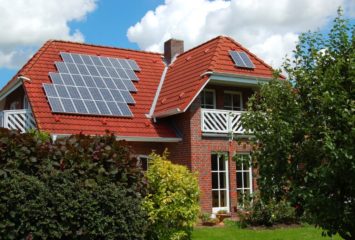
For the past decade, the popularity of solar energy worldwide has been growing rapidly. Most people have seen solar panels being installed on houses and businesses in their community, usually in the form of large silver rectangular panels spread out across a roof or other free-standing structures, such as a carport cover, or even the sunroof of a car.
When it comes to choices, aesthetics almost always yields to functionality. A few companies such as SunPower have created all-black solar panels, which blend in a bit more than other models, but this doesn’t change the clunky look of the panels themselves. Fortunately, recent breakthroughs in thin-film design have lead to the more integrated approach, such as that offered by solar “shingles.”
Solar shingles, or photovoltaic shingles, were first released to the mass market in 2005. Similar to solar panels, solar shingles capture sunlight and transform it into re-usable energy. Solar shingles are typically smaller than panels, though — 12″ wide and 86″ long — and can be stapled directly to roofing cloth, just like normal shingles. Once installed, they give the roof a purplish-blue tint, but otherwise they look like regular tar and sand shingles.
Electricity is generated from solar shingles when the sun strikes a semiconductor layer, typically made from crystalline silicon and laminated to the shingle’s surface. According to an article on Thisoldhouse.com, a single solar shingle produces about 50-200 watts of energy, enough to power a wall fan. Not bad for one tiny shingle; imagine what you could do with a whole roof-load?
One of the big challenges in using traditional solar panels is determining how many to install. They aren’t widely available in small sizes, so many customers end up buying more or less than the amount they need. With smaller solar shingles, it’s easier to get just the coverage you want.
Another article on Hubpages.com states that solar shingles can create enough energy for the average household for up to 40 years! Given that most people replace traditional shingles at least once every 15-20 years, this means solar shingles could cut down on overall maintenance costs, in addition to generating more sustainable energy.
Of course, the biggest payoff with any solar technology is the savings in transporting energy to its end-use location. With traditional coal or nuclear energy, valuable power is used just to transfer it along city lines and to the countryside. Micro-power, such as a localized solar installation, solves this problem and reduces overall waste.
As with solar panels, energy generated from solar shingles is stored locally in a battery, or passed through to the grid using net metering. Net metering is a system designed to let businesses and home owners use energy from traditional sources when they need it, and share extra power when they are producing it themselves, effectively “netting out” their energy use. Energy shared with the grid is passed on to the community; the more power-producing structures in a community, the more stable and efficient the community’s power becomes.
Wikipedia states: “Backup storage, in the form of batteries, is expensive, adds complexity to the installation, and is uneconomic in any large scale.” While it’s true that battery units require an array of additional hardware (batteries, battery enclosures, battery charge controllers, and separate sub panels for critical load circuits) they are useful as a backup system or even for primary use, particularly if you live far from an established grid or don’t have access to net metering. In some situations, an electric car can act as a giant battery — future smart grids may even draw on parked cars for power during peak loads and to reduce the need for expanded coal capacity.
Are solar shingles expensive? Well, compared to traditional solar panels, the answer is no. One author on Hubpages.com claims that you will not only be reducing your monthly energy bill, but increasing the overall value of your house by as much as 4%. With the prices of energy and building materials in constant flux, locking in your rates by tethering to solar energy might be a wise decision which could increase your property value. In addition, when your neighbors experience brown-outs or complete power outages, your home will be fine.
An article on Hubpages.com also claims that installing solar shingles “gives you back a price premium of about 10%, which is an increased value of your property, after making it energy-efficient and renewable.” So, depending on your situation as a home owner, this return could represent a 6% increase in value from day one with ongoing benefits, minus the cost of interest if you have to take out a loan.
Older solar shingle models were more expensive because they represented a new technology — recent models made with thin-film copper indium gallium selenide (CIGS) are far more affordable and can be installed in as little as 10 hours, instead of 22-30 hours for large solar panels. They are also lighter in weight, making them ideal for older structures or buildings already under stress.
Companies that currently manufacture solar shingles include SunPower Corporation, Solar Components Corporation, Atlantis Energy Systems, and Dow Chemical. In addition, large home-builders in California are partnering with companies like SunPower to offer homes with pre-installed solar systems. This is a wonderful option, because the costs of rewiring and reinforcing a roof for solar can take up as much as 50% of the overall costs to go solar, and regularly becomes a deciding factor for families who are considering renewable energy down the road. Even without pre-installed panels or shingles, homes that are “solar ready” are worth more in the long term and for resale purposes.
In recent years, another new technology has also become available: peel-n-stick solar shingles. These work really well for metal roofs, and can generate around 130 watts of energy each.